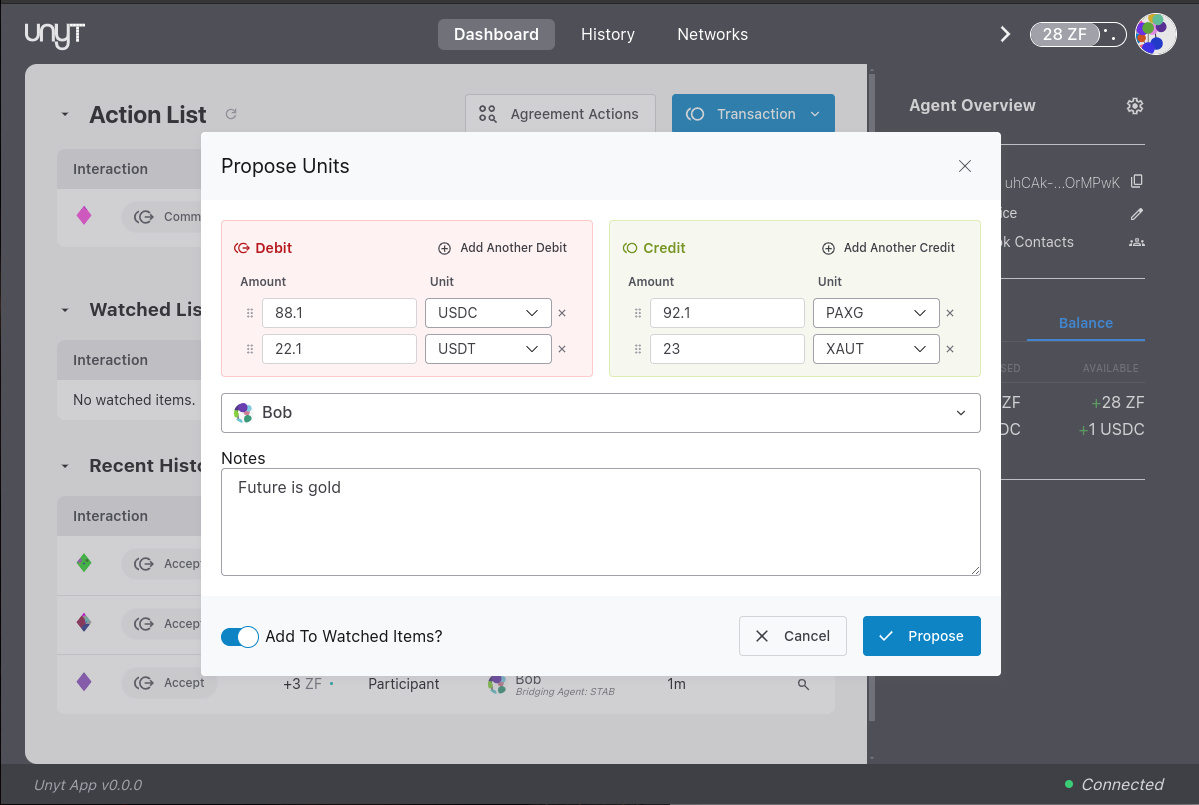
Included in our release on Wednesday, Unyt now enables a transaction type that we call trades. Two parties can now trade a bunch of various units for another bunch of other units.
For example, Alice can pay 2.5 gold-ounce units & 3.2 ETH to get 0.11 House ownership units from Bob.
I know those units sound funny, but the point is this can happen in a normal P2P transaction. No smart contract or Unyt agreements. Not an order on an exchange. No trading pairs or liquidity pools.
The movement of units in the transaction is atomic -- meaning they either all succeed and transfer, or they all fail and revert back to their original owner. There are no units stranded in some intermediate state along the way.
This is just one way Unyt will be disruptive to the crypto industry. Seems like kind of a big deal to have atomic trades as a native crypto transaction, without requiring intermediary exchanges and order books.
A likely emerging use case
Picture a scenario where:
- Holo Hosting is running a Unyt accounting instance which uses HoloFuel as a means of payment for various service units (MB of storage, bandwidth, CPU processing, # of gets serviced, etc.)
- The Mycelium Network is running a Unyt accounting instance which uses Spore to pay their cloud and AI hosts for service units (elapsed wall clock time for running cloud hosts, # Tokens processed for AI queries, compute load for AI agents, etc.)
- Both Holo and Mycelium participate in a shared marketplace with other projects and communities where each bridge their units into the same shared Unyt instance.
- Alice has a HoloPort and is earning HoloFuel for the hosting she listed in the shared marketplace and she wants to spend it on running an AI agent on the Mycelium Network.
Normally, Alice would have to trade HoloFuel for Spore somewhere, transfer it into an exchange, navigate through some series of trading pairs, deal with the liquidity pools available for each particular unit, pay gas fees along the way, and possibly even bridge across chains, etc.
In Unyt, Alice's earnings come into her marketplace account, where she can accept payment in HoloFuel as well as a blend of whatever other units people have to spend. And she can pay for her AI agent in HoloFuel or whatever other units she's been paid in.
How can that possibly work? How do we know what number of units to pay for what other units?
Conversion rates
In this marketplace scenario, there is a conversion table updated daily which references each unit to its price in dollars, enabling an easy calculation to convert between any of the participating units.
We can probably write a whole blog post on the the various possible sources for market prices, but lets keep this story simple. In this case, product providers (e.g. Holo hosts and Mycelium hosts) all set their prices in dollars. One easy formula to compute the value of Spore in dollars: X Spore purchase Y dollars of services yesterday; so 1 dollar = X/Y Spore.
This is price derived from economic activity and actual utility rather than by speculation.
As long as we have fair conversion rates between the various units, the Unyt app can enable any number of specific units to be spent for products or services, or traded.
How much capacity sits idle because we lack the "right" currency? Accounting has always tracked many forms of value -- now payments can too. No more forcing every exchange of value through a single-currency bottleneck. Two parties agree, value flows. That's it.
What's next?
Implementing trades also impacted Unyt's transaction workflows which let us add some user-requested features that we think you'll be happy to see. Another post is coming with a demo and documentation of the workflows.
Screenshot: Seems unlikely Bob will accept so little USD for his gold